


Homeless Health Conference 2026
A waiting list is now in operation for this year’s Homeless Health Conference, please visit the event registration page and add your name to the wait list here and we will be in touch if a place becomes available. (We do our best to accommodate as many people as possible and cancellations do arise as the event gets nearer.)
The conference will take place on Wednesday 21st October at the University of Sussex’s Conference Centre.
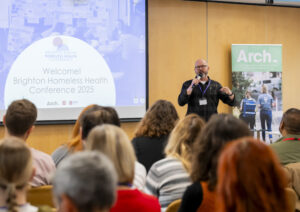
This one-day, free event, is designed to inspire, connect and equip people who work in homelessness services with lots of practical information about the health needs of people experiencing homelessness. It has the ultimate goal of improving health outcomes in this vulnerable community.
Sessions at this year’s event include:
- Emotional Regulation and Grounding Techniques
- Healthcare for vulnerable migrants
- Perinatal Substance Misuse
- End of Life Care in Hostels
- Infectious Diseases
- The Mental Health Act and The Mental Capacity Act
- Women’s experiences of drug and alcohol services…
…plus many more topics. As in previous years, the focus will be on homelessness and health related issues for people in Brighton & Hove so sessions are likely to refer to local services, organisations and programmes. The event is designed with local frontline workers in mind.
Click on the title of a session to see the talk outline
Perinatal Substance Misuse
This session will explore substance misuse in pregnancy and the perinatal period through the lens of homelessness and multiple disadvantage. Women experiencing homelessness are disproportionately affected by substance misuse, trauma, mental health difficulties and safeguarding concerns, yet often face significant barriers when engaging with healthcare services. The presentation will provide an overview of the clinical issues, discuss practical approaches to engagement, and consider how services can work together to improve outcomes for mothers and babies.
The session will be delivered in a lecture format with time for questions and discussion. The objective is for delegates to leave with a greater understanding of the needs of this vulnerable population, increased confidence in recognising risk and responding appropriately, and a better appreciation of the importance of integrated, trauma-informed care.
Speaker: Dr Matthew O’Brien, CGL
Content warning: This presentation will include discussion of substance misuse during pregnancy and the perinatal period, including the impact of alcohol and drug use on mothers, unborn babies and families. The session will explore themes of trauma, adverse childhood experiences, domestic abuse, child safeguarding, child protection processes, neonatal withdrawal, loss, and the wider social factors associated with substance misuse and exclusion. Clinical case examples will be used to illustrate key learning points and may describe situations that some attendees find upsetting or emotionally challenging.
While the presentation is educational in nature, delegates with personal or professional experience of substance misuse, pregnancy loss, child removal, trauma, domestic abuse, or homelessness may find some of the content distressing. Attendees are encouraged to engage with the session in a way that feels safe and appropriate for them and to take a break if needed.
Emotional Regulation & Grounding - a practical session
Many of our service-users experience intense and at times overwhelming emotions. These can be difficult to manage, whether they come up in appointments with professionals or in people’s daily lives. This session will go through a range of different emotional regulation and grounding techniques. We will practise using them and discuss their best uses. The aim of the session is for everyone to have some additional tools available when someone becomes distressed in an appointment. Some of the techniques may also be taught to service users.
Speaker: Dr Gabriel Schnitzer, SPFT
Content warning: We will touch on some reasons for emotional dysregulation (e.g., trauma) as well as some trauma symptoms (e.g., flashbacks). But there will not be a discussion of any details of traumatic events or content of flashbacks.
Beyond the Basics: Understanding Occupational Therapy in Homeless Healthcare
The aim of the talk is to support delegates to understand what occupational therapy is and its role within homeless inclusion health, how to refer patients to our team and complete the referral form, how we assess patients, case studies, barriers within the system, success stories and future roles of OT working within hostels. The session will mainly follow a lecture style with some interactive elements.
Speakers: Gemma Buckley & Mario Garcia Cabanas – SCFT Homeless Team
Content warning: We will cover case studies which include potentially upsetting situations as they are based on real life stories. We will highlight the vulnerability of the patients we work with and look at their compound needs.
Reflections on a Good Death whilst Homeless - A Collaborative Approach
This session looks at why it’s important to talk about death and dying whilst working with people who are homeless and vulnerably housed. We will consider different perspectives on what makes a ‘good death’; and gently look at the audience’s own beliefs around death and dying as well as cultural beliefs and societal norms.
The session includes case studies from professionals’ experiences of supporting people who were dying and homeless – the challenges they faced and learnings from this. We will also consider solutions to improve outcomes for people who are dying and homeless.
Speakers:
Caterina Speight – SCFT Homeless Team
Dr Tal Lewin – Arch Healthcare
Leila Chinehasha & Helen Lyons – Martlets Hospice
Paul Williams – St Mungo’s / Housing First
Content warning: This can be quite an emotive and evocative session and people should feel free to leave if they feel upset during the session. It will touch on bereavement, grief/loss, deteriorating patient, death and dying, as well as reflections on our own thoughts around death and dying. We would also recommend having a way to debrief with someone afterwards or feel free to speak with one of the speakers after the session.
The Conversation We're Not Having (Yet): Hormones, Substances, Trauma and Mental Health - And What This Means for Women
Hormones affect so much of our physical and mental wellbeing and using substances or entering recovery adds a whole extra layer to this. Hormones and substances interact with trauma, mental health and physical health, yet these links are rarely discussed.
Join us to learn more about how women’s hormones, substances, trauma and mental health connect and how this can all affect women’s recovery and where the relapse risks are. We will also be launching our new recommendations on hormonal health for services, and explore what hormone-informed working could look like in your own role.
This is an interactive session for everyone, whatever your role or gender. No medical knowledge needed, and no one will be put on the spot. We hope to co-produce actions and resources with you and you’ll leave with something you can do next week.
Speakers: Common Ambition Women’s Drug and Alcohol Group
Content warning: This session will cover topics relating to substance use, mental health and trauma and will be led by women who have experience of this. However we will ensure a trauma-informed space and be action focussed rather than sharing any personal experiences.
Enhanced Support Team Lived Experience
The session will begin with a brief introduction to the newly formed Enhanced Support Team, setting the context for the work we are undertaking with individuals experiencing addiction and multiple disadvantage. The main focus of the session will be led by Becca and Jon, our Peer Support Workers, who will explore why lived experience is a cornerstone of effective addiction support. Drawing on their own recovery journeys, they will demonstrate how lived experience can offer a unique depth of empathy, credibility and insight that complements professional expertise.
Through a combination of presentation, discussion and audience participation, Becca and Jon will highlight how peer support can help overcome barriers of shame and stigma, build trust and engagement, and support individuals who may be in the pre-contemplation stage of change or experiencing repeated lapses and relapses. The session will also explore the early stages of recovery, the importance of developing self-awareness, and the transformative impact that a meaningful question can have in helping someone begin to consider change. Attendees will leave with a greater understanding of the value of lived experience within addiction services and practical insights into how peer-led approaches can support engagement and recovery outcomes.
Speakers: Holly Croydon – BHCC, Jon Wilde – CGL, Rebecca Parry – CGL
Content warning: This session will include discussion of addiction, substance use, recovery journeys, relapse, stigma and the barriers people can face when seeking support. Becca and Jon will draw on their own lived experience of addiction and recovery, and may reference situations that some attendees might find emotionally challenging. While the session will focus on hope, recovery and the value of peer support, participants should be aware that themes of trauma, social exclusion, homelessness, and the impacts of addiction on individuals and their relationships may also be explored. Audience members are encouraged to engage at a level that feels comfortable for them and to take breaks if needed.
Improving the Healthcare of Migrants in Vulnerable Situations: A Case-based Workshop
This workshop aims to share practical advice for identifying the health needs of migrants in vulnerable situations and advocating for their access to healthcare. The session is built around a fictional case study of a young woman and man from Sudan. Their story will provide a focus for discussions about the impact of being displaced, migration journeys, the asylum process, assessing health needs, and improving access to healthcare.
Speakers: Jane Smith – Refugee Radio, Dr Joe Bourdillon-Schicker – Portslade Health Centre and Medical Justice, Dr Kate Pitt – Arch Healthcare
Content Warning: This session will include a fictional case study of two people seeking asylum from Sudan, which is currently affected by civil war and a humanitarian crisis. The session will include discussions about migration stories and experiences of the asylum process. There may also be discussion of trauma secondary to gender-based violence.
The Changing Face of HIV
This session will provide an update on the changing face of HIV and challenges in getting towards zero HIV transmissions. Complex case scenarios will also be included.
Speakers: Dr Duncan Churchill and Eileen Nixon – The Lawson Unit, RSCH
Content Warning: The case scenarios will include potentially upsetting situations / circumstances depending on the audience’s experience of working with vulnerable groups.
When to Worry – and What to Do: Recognising Deterioration and Knowing When to Seek Medical Help
This talk aims to support delegates to recognise features of serious illness in their clients. It will cover signs and symptoms of urgent and life threatening conditions, and how to seek appropriate support. This is a lecture style talk with time for questions at the end.
Speaker: Dr Robyn Daniel – Arch Healthcare
Content warning: This talk will provide detail on medical conditions, both physical and mental. It will include details (including illustrations and photos) of serious illness, and discussion around emergency care.
Bugs and Barriers: Updates on Bacterial Infections in Marginalised Groups
Bacterial infections are incredibly common problems in people who inject drugs and people experiencing homelessness. In this interactive session we will cover the basics of bacterial infections including invasive group A strep, learn about trends in local and national data, discuss healthcare barriers for people with infections, and consider dilemmas in antibiotic prescribing. This will be a hybrid session with lecture slides, interactive activities, and time for questions and discussion at the end.
Speaker: Dr Daisy Woolham – University Hospitals Sussex/Brighton and Sussex Medical School
Content Warning: This talk will discuss a fictionalised patient’s experience of healthcare and hospitalisation with a serious bacterial infection; this may be triggering or upsetting for people with similar lived experiences. It will also include example photographs of wounds and skin infections.
Why Won’t Someone Do Something to Help? The Mental Health Act and Mental Capacity Act Explained.
Trying to protect our clients when they struggle to protect themselves is one of the hardest roles as a frontline worker. This session offers a chance to gain a better understanding of when the MHA and MCA can be used as well as their limitations and the risks to clients when they are applied. We also hope to discuss what to do when these Acts aren’t appropriate.
It is our hope that attendees will come away feeling more empowered to advocate for clients in these difficult situations, and with deeper appreciation of the context in which decisions are made.
Speaker: Dr Tim Worthley, Arch Healthcare
Content warning: This session will touch on serious mental illness and mental health conditions, there may be discussion on suicidality.